
By Marx Itamalo |
THE police in Omusati region have warned residents of the region who bath in the Namwater canal that they will face the ire of the law if they do not stop the indecent practice.
This is according to police regional commander for Omusati commissioner Ismael Basson in an interview with Omutumwa this week.
According to Basson, a lot of people, including women, bath totally naked in the canal which is an eyesore to people living along the canal as well as travelers driving along the Outapi-Ruacana main road.
These people, Basson said, will be punished by the police in accordance with the applicable laws.
“We have a lot of people breaking the law by bathing in the canal especially on the stretch of the canal between Outapi and Ruacana more specifically at Epalela location,” Omusati’s top cop said.
“It is totally nauseating. The canal is close to homesteads and the main road but these people are bathing naked there totally unperturbed or without any care.”
According to him, school children from the surrounding areas also pass through the area and it is not a good sight for them to see people bathing in the canal. He added that most of the people suspected of bathing in the canal are those from faraway places.
“We want to urge them to stop the practice. Coming in the public naked is public indecency and is punishable by law. Therefore, they should stop. That canal is close to the road and it is a bad sight for travelers to see people naked along the canal.”
Basson pointed out that the regional police went on an operation five years ago to arrest and issue spot fines and admission of guilty fines to people who were found bathing along the canal and the practice came to a screeching halt then but it has now resurfaced.
“Several were arrested and fined. They stopped for the past three years or so but they have started now. Maybe they think we have forgotten. We have not. We will start dealing with them again.
“That canal is used by people for many reasons including those that fetch water from it for different household chores. We cannot have people bathing in it.”
The police commander nonetheless pointed out that the police will first start with an education campaign to educate the people living along the canal why it is wrong to bath in the canal, and only after that will those found doing it receive corresponding sanctions.
Asked about the incidents of people drowning in the canal, Basson stressed there has been many cases of people drowning in the canal over the years but the cases of deaths due to drowning in the canal have decreased.
“We used to have people especially the elderly and children who come to fetch water from the canal as the most victims, but the numbers have gone down now,” he said, explaining that those who were drunk used to be the most common victims.
Basson stated also that the police have discovered most drownings happened where the canal was slippery.
“Our warning is for the people to be extremely careful when fetching water from the canal or when crossing it. They should know the canal is deep and can be dangerous,” he warned.
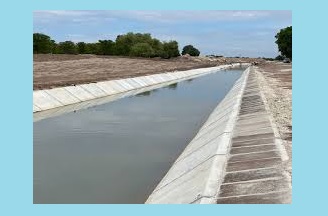
The 150 km Namwater canal was constructed by the colonial South African government in 1972 to transport water from the Calueque dam in Southern Angola to the Etaka dam at Olushandja whereby the water is transported further to Namwater’s water treatment plants at Oshakati before it is distributed across many parts of northern Namibia for both human and animal consumption.
In the photo: The water canal which is a source of water for most parts of the north of Namibia.