
By Marx Itamalo |
THE annual floods known as efundja in northern Namibia is on its way from southern Angola.
This week, Oshikango regional councilor Ester Ndatala Nghidinua told Omutumwa that authorities in neighbouring Angola have notified their counterparts in Namibia about the water flowing downwards.
Nghidinua said residents would be notified accordingly for them to be ready to be relocated anytime when the flood reached Namibia.
Onamhinda village in Oshikango constituency is the worst hit village in Ohangwena during any efundja year followed by several other villages in both Oshikango and Ohangwena constituencies.
The councilor further highlighted that the Ohangwena Regional Council will not tolerate residents who refuse to be relocated because they fear their properties would be stolen during their absence.
During relocation, affected residents are provided with all essential goods such as tents, mattresses, blankets and food.
The last efundja hit northern Namibia during January 2025 when it reached parts of Ohangwena, Oshana and Omusati regions. It flooded homes, schools, clinics and some businesses leading to the closure of some businesses and schools for a lengthy period. It also washed away some roads in these regions especially those made up of gravel.
Omutumwa spoke to some residents of Oshikango to have their views on the news of the coming efundja. One of them Tulonga Nhinda, who is from Olunghono village, said that if the news is true, it would be the first time in many years for the efundja to come in two consecutive years.
“Typically, it comes after two or three years or even more. But if it is on the way again, many of us will be surprised,” he said.
Nhinda’s traditional house is on the efundja path and the family always gets relocated to high ground.
He nonetheless indicated that despite the destruction the deluge does to his home, the benefits it brings outweighs the risks associated with it.
During the efundja season people of northern Namibia have an abundance of fish which come with the water. During this time, people could be found fishing with nets or hooks in the oshanas.
Selma Ngweda says although her home is not on the path of the efundja, she reaps the benefits of the fruits associated with efundja each season.
“People always have plenty of fish to eat and each person has an income. Although travelling and other logistics are affected in some places, people don’t go hungry.”
The efundja water which floods Ohangwena, Omusati and parts of Oshana and Oshikoto enters northern Namibia when the Kunene river, which forms the frontier between north-western Namibia and southern Angola breaks its banks.
The Kunene, part of the Cuvelai basin, spills into northern Namibia whenever it is fed with much water from the Gove dam, a large dam situated 75 kilometers in Huambo, Huila province, central Angola.
The Gove receives its water from the Angolan highlands and whenever it reaches capacity, the sluices are opened, releasing water into the Kunene, which in turn, spills over into southern Angola and northern Namibia plains, causing massive flooding.
The last time this happened was in January 2025 when flooding displaced hundreds, closed schools, businesses and rural clinics in Ohangwena, Omusati and parts of Oshana and Oshikoto regions.
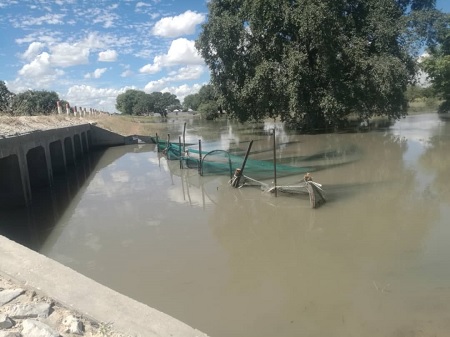
In the photo: January 2025’s flooding.