
By Victor Angula|
Namibia is like a pregnant community in need of someone with knowledge, experience and passion for the service of being its midwife.
The work to be done by the midwife is the work of housing delivery.
Namibia is said to have a backlog of 300 000 housing units. That is 300 000 houses urgently needed by a country with a population of 3 million.
Around 77 000 children are born in Namibia every year. Every day 208 babies are born in Namibia. In comparison, 1 800 houses are built in Namibia in a year. That is five houses built in a day in Namibia.
Despite the efforts of private and state-owned entities in the sector of housing delivery, a small population of 3 million souls has for decades struggled with the work of housing delivery, although it has done much better when it comes to the delivery of babies.
But there has been one entity known as Shack Dwellers Federation of Namibia (SDFN).
“The Shack Dwellers Federation of Namibia was established in the year 1995,” says Ms Martha Nuukongo Kaulwa. “Since then there has only been a small change of its structure, but the aim has remained the same, which is to organise low-income earners for them to acquire housing.”
In partnership with the Namibia Housing Action Group, a non-governmental organisation based in Windhoek, the Shack Dwellers Federation of Namibia has come a long way in the efforts to live up to its mandate of providing housing opportunities to low-income earners.
With Ms Kaulwa, who is the National Facilitator of the SDFN, based in Oshakati, together with her co-national facilitator, Ms Edith Mbanga, who is based in Windhoek, the Federation has done a lot much better than some housing provision entities which either are private-owned or are funded by tax-payers money and are run on business principles.
This is despite the fact that the SDFN has faced an uphill battle in the efforts to deliver decent housing as a result of the ever-increasing shack dwellings in Namibia, persistent income inequalities, high unemployment and economic difficulties faced by people at the bottom of the economic pyramid.
Although the success of SDFN/NHAG is modest, having delivered 556 houses during the financial year 2024/2025, and a total of more than 8,000 houses over the period of its existence, the value in SDFN lies in the fact that this is the only institution trying to build Namibia from the bottom.
It is the one institution which is trying to deliver houses by making the people in informal settlements to do it for themselves. It is the entity that makes the people to save up and engage in processes which move them from shack dwellings to decent housing.
Omutumwa sat down with Ms Kaulwa to get a glimpse into the operations of SDFN, known popularly as “the Federation”.
Kaulwa explained that the Federation is a network of savings groups across the country of which in 2024 they stood at 1 000, with Erongo Region having the highest number at 244 groups while Hardap Region had the lowest number of groups at 18.
“Sometimes the number of groups fluctuate depending on demand,” Kaulwa said. “And when there is no delivery of land people lose interest and moral, which makes the number of groups to go down.
“We do motivate the people to remain in the savings groups, but it all depends on the people’s will and desire to stick together in the groups despite the challenges.
“The main challenge is land delivery. Land is not given every day. And when land is given there is a process before building begins.”
She explained that the Federation’s activities are powered by a combination of government and partners from the private sector, and non-governmental organisations. In the financial year 2024/25 the government of Namibia through the Ministry of Urban and Rural Development was reported to have given an allocation of N$32,4 million, supporting the construction of 556 houses.
However the activities of the Federation are largely directed by the Namibia Housing Action Group (NHAG) Trust, which is a non-governmental service organisation dedicated to supporting and enhancing the initiatives of the Shack Dwellers Federation of Namibia. With a staff of 10 fulltime employees, NHAG provides administrative and technical support to the Shack Dwellers Federation, helping to connect poor communities to the formal sector.
NHAG also administers the Twahangana Fund, which is the community-managed development fund of the Shack Dwellers Federation of Namibia.
The fund is where donations from the Federation’s various partners are put, before they are given out as loans to the beneficiaries.
“For a beneficiary to qualify for this loan, he or she must be a member of a savings group, a group that has desire to build themselves houses,” Ms Kaulwa said. “And the funds are released once land has been allocated by the town council where the beneficiaries reside.”
Kaulwa explained that “for a member to qualify, we look at not only how consistently he or she has been saving up in the group account, but also how consistent is the person when it comes to attendance of the savings group meetings, and also participation in the Federation’s activities.”
A loan is given, which is payable over a period of 11 years, for which the highest amounts given so far are for those in Erongo Region.
“The amount is determined by the cost involved, but the highest amount given so far was N$42,000 for those beneficiaries in Erongo because in Erongo a house needs some building materials which are different from the rest of the country.”
With this loan the person is expected to build a two-roomed house. And pay back the money over a period of 11 years.
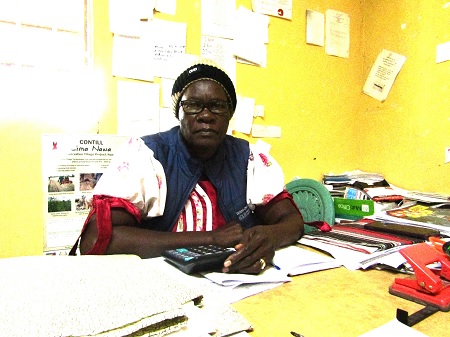
In the photo: Oshakati-based National Facilitator of the Shack Dwellers Federation of Namibia, Ms Martha Kaulwa, at the Federation’s office at Evululuko in Oshakati East.