
The Government Institutions Pension Fund (GIPF) briefed the Parliamentary Joint Committees on Economy and Industry, Public Administration and Planning, and Public Accounts yesterday.
The briefing covered the Fund’s mandate and governance, financial position, investment process, portfolio and impact on the Namibian economy.
The parliamentary committee was told that as at 31 March 2026, the Fund’s total assets stood at N$210.1 billion, up 15% from N$183.0 billion a year earlier.
Net investment income rose 77% to N$29.6 billion. The latest actuarial valuation puts the funding level at 130%, with a surplus of about N$47 billion over estimated liabilities.
The Fund holds about 69.4% of all retirement-fund assets in Namibia.
GIPF serves 171,381 people: 113,167 active members and 57,881 pensioners and beneficiaries. In the year ending 31 March 2026 it received N$5.6 billion in contributions and paid out N$7.3 billion in benefits.
Between 2015 and 2026, pension increments averaged 5.13% a year against average inflation of 4.56%.
On sound governance and a disciplined investment processes, the officials of the GIPF stated that the fund is a defined benefit fund supervised by NAMFISA. It is governed by a Board of Trustees supported by specialist committees, independent actuaries, custodians and consultants.
The investment target is inflation plus 5%.
External managers are selected through a structured process of tender, screening, due diligence and Board appointment.
As at 31 March 2026, all regulatory investment limits were met. These include 47.74% of assets invested domestically against a 45% minimum, and 36.03% in foreign assets against a 40% maximum.
GIPF has N$7.8 billion in unlisted investments across Namibia’s regions. Its alternatives portfolio has funded renewable energy with N$2.7 billion, supporting 171 MW of capacity.
On dousing, 8,595 houses were built and 5,019 plots serviced.
GIPF also has invested in 10 shopping centres, and also in agribusiness, education and health. Mashare Berries in Kavango East created more than 100 permanent jobs and attracted cross-border co-investment.
Other examples include student accommodation, Osona development, the Oshana and Walvis Bay Gymnasiums, and Ongwediva Medipark.
GIPF has a pension-backed home loan scheme. The N$900 million Pension-Backed Home Loans Scheme (PBHLS) is showing strong member demand. The scheme is available to active members (members who are currently employed and contributing monthly towards their pension) to construct new houses or renovate existing homes, purchase land in both urban and rural areas or proclaimed or unproclaimed.
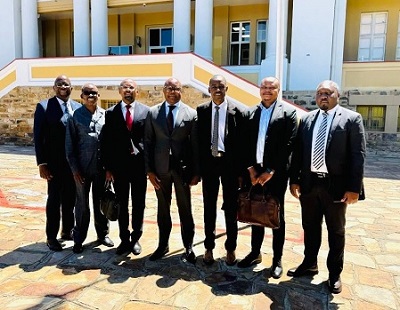
In the photo: The officials of GIPF on a parliamentary visit.