
 The Bank of Namibia released the Economic Outlook update for August 2026, with the domestic economy estimated to expand marginally by 2.1 percent in 2026 and 2.8 percent in 2027.
On the other hand the global economic growth is expected to decline in 2026, mainly due to disruptions associated with the conflict in the Middle East, before improving slightly in 2027.
“According to the July 2026 IMF World Economic Outlook (WEO) update, growth is forecasted to decrease to 3.0 percent in 2026 and then increase slightly to 3.4 percent in 2027, remaining below the 3.5 percent recorded in 2025,” said Bank of Namibia’s Director for Strategic Communications and International Relations Mr Kazembire Zemburuka.
In advanced economies, growth is projected to slow in both 2026 and 2027. The IMF projects growth in advanced economies (AEs) to drop from 1.9 percent in 2025 to 1.7 percent in 2026 and 1.8 percent in 2027, on account of monetary policy tightening, conflict in the Middle East, and softer demand momentum.
Growth in Sub-Saharan African economies is expected to decline in 2026 before increasing modestly in 2027. GDP growth in the Sub-Saharan African (SSA) region is projected to fall slightly from 4.5 percent in 2025 to 4.3 percent in 2026 and increase to 4.5 percent in 2027.
“Similarly, the World Bank forecasts growth in SSA economies at 4.1 percent in 2026 and 4.2 percent in 2027.
“Namibia’s GDP growth is projected to improve gradually in 2026 and 2027, following weak growth in 2025. Real GDP grew by 1.7 percent in 2025 and is projected to make a recovery to 2.1 percent in 2026, before strengthening further to 2.8 percent in 2027.
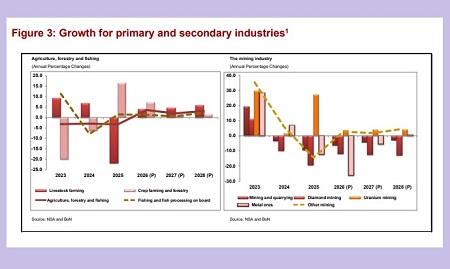
“The anticipated recovery in 2026 is underpinned by a rebound in agricultural output on the back of improved early-season rainfall, sustained strength in uranium mining, and continued robust growth in wholesale and retail trade and construction, notwithstanding the persistent deep contraction in diamond mining and metal ores.
“Growth is projected to strengthen further in 2027 as manufacturing returns to positive territory and the contraction in primary industries narrows.
“The 2026 growth estimate represents a downward revision of 0.5 percentage point relative to the March 2026 Economic Outlook update, as a deeper-than-anticipated contraction in diamond mining and softer construction activity outweigh the improved outlook for agriculture.
“The prolonged war in the Middle East has further contributed to this poorer growth outlook, though increased input costs (mainly fuel), enhanced scarcity of some imported inputs (e.g. sulphur), and worsening of transportation and logistics.
“The domestic economic outlook remains subject to several downside risks from both external and domestic developments.
“Regionally, the outbreak of Foot-and-Mouth Disease in neighboring countries, particularly Botswana and South Africa, poses a risk to livestock production and export earnings.
“Globally, ongoing geopolitical tensions, as well as evolving United States policies, may contribute to volatility in commodity prices, exchange rates, and the cost of key imported inputs such as fuel.”
In the photo: Secondary industries growth is projected to slow in 2026, before recovering markedly in 2027.