Learners from six schools visited the United Nations in Namibia for the first time and discovered something remarkable: despite their different backgrounds, many shared the same hopes for Namibia’s future and the Planet.
The room was filled with unfamiliar faces, excited conversations and a sense of curiosity.
For many of the 140 learners gathered at the United Nations House in Windhoek on 10 June 2026, it was their first visit to the United Nations.
They had travelled from A.I. Steenkamp Primary School, Bet-El Primary School, Elim Primary School, Goreangab Junior Secondary School, Jan Jonker Afrikaner Secondary School and Windhoek International School to participate in the annual UN4U and SDG Educational Outreach Programme.
They arrived from different schools, communities and circumstances.
What none of them knew at the start of the morning was how much they had in common.
In her opening remarks, United Nations Resident Coordinator Hopolang Phororo challenged learners to think about the changes they would like to see in their communities.
“If you had the power to change one thing in your community today to make it fairer, safer or greener, what would it be?” she asked.
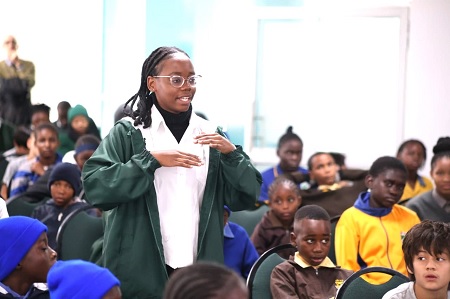
Hands immediately shot into the air.
Across the room, learners spoke passionately about better healthcare, cleaner environments, stronger education systems and expanded opportunities through quality education, skills development and employment.
As the discussion continued, a pattern quickly emerged.
Although the learners came from different schools and backgrounds, many cared deeply about the same issues and shared similar aspirations for their communities and country, which mirror the 2030 Agenda and the Sustainable Development Goals (SDGs).
“The solutions already exist in this room,” Phororo reminded them.
That message would resonate throughout the morning.
Through interactive discussions facilitated by Emma Mbekele of the United Nations Population Fund (UNFPA) and Anthea Basson of the Resident Coordinator’s Office, learners explored the work of the United Nations in Namibia, the Sustainable Development Goals (SDGs), the principle of Leave No One Behind and the Pact for the Future, a global agreement adopted by world leaders in 2024 to strengthen international cooperation on issues such as sustainable development, peace, technology and inclusive participation.
The sessions were designed as conversations rather than lectures, encouraging learners to ask questions, share opinions and work through challenges together.
When asked to identify some of the world’s biggest challenges, the answers came quickly. Poverty. Pollution. Water shortages. Unemployment. Climate change. Conflict.
What stood out was their awareness of these issues, and the fact that these ideas emerged from the learners themselves. Without prompting, they identified many of the same challenges facing Namibia and the world and began exploring how those challenges connect to one another.
Learners recognised that access to quality education creates pathways to employment, that clean water is essential for health, and that protecting the environment supports livelihoods and food security.
In doing so, they demonstrated an understanding of sustainable development that went beyond individual issues and focused on how solutions work together.
The principle of Leave No One Behind sparked thoughtful discussions about inclusion, dignity and equal opportunity.
Learners reflected on the importance of ensuring that everyone has the chance to participate and contribute, regardless of age, income, gender or disability.
The conversation about the Pact for the Future generated equal interest.
Many were surprised to learn that Namibia played a leadership role alongside Germany in helping facilitate global negotiations that resulted in the Pact for the Future, demonstrating that countries of all sizes can help shape global solutions.
As discussions turned to climate action, technology, peace and participation, learners increasingly connected global priorities to their own ambitions.
“I want to study medicine because there are a lot of sick people who need help,” one learner said.
Others spoke about becoming teachers, engineers, entrepreneurs and environmental advocates.
Another learner reflected on the role individuals can play in creating positive change.
“I want to stop pollution because it affects our environment and our future. If we all do our part, we can make our communities cleaner and healthier,” the learner stated.
The comments echoed many of the themes emerging throughout the discussions. Learners were not only identifying challenges. They were already thinking about solutions and the role they could play in creating them.
Their aspirations reflected a growing understanding that careers are not only personal ambitions but also opportunities to contribute to society.
As the morning progressed, learners became increasingly confident in sharing their views and proposing solutions.
The programme demonstrated that meaningful participation begins long before adulthood. Through informed engagement, learners can help shape the communities and future they wish to see, even before entering professional or leadership roles.
By encouraging learners to voice their opinions, discuss solutions and engage with issues affecting their communities, the programme provided a practical introduction to active citizenship, civic responsibility and meaningful participation in public life.
Throughout the morning, they practised skills that will serve them throughout their lives: listening to different perspectives, asking questions, analysing problems and articulating their own ideas.
The experience highlighted the value of creating spaces where learners can engage directly with national and global issues and recognise their role as active contributors to Namibia’s future.
As the programme drew to a close, learners were asked how they would respond when they see something unfair in their communities.
One response captured the spirit of the morning. “I would stand up for what is wrong because at times we feel we cannot speak because we are small. But whether my voice is soft or loud, what is wrong is wrong and what is right is right.”
It was a simple statement.
Yet it reflected the confidence, conviction and sense of responsibility that had emerged throughout the day.
For a few hours, the United Nations House transformed from a workspace into a hub of youthful energy and ideas.
It became a space where learners could speak, question, challenge ideas and imagine solutions.
More importantly, it became a reminder that meaningful participation begins when learners are given opportunities to be heard, express their views and contribute to discussions about issues that affect their lives and communities.
The future of Namibia is not waiting somewhere ahead.
It was already present in the room. In the questions learners asked. In the solutions they proposed. And in the confidence with which they spoke about the country they hope to build.
In the photo: A learner from Jan Jonker Afrikaner Secondary School contributes to discussions during the UN4U and SDG Educational Outreach Programme. The programme encouraged learners to find their voice, share their ideas and recognise that meaningful participation begins long before adulthood.