
The Brown Hyena: Our Natural Diamond Story of Shared Responsibility
By Dene Namukomba |
In Namibia, the story of natural diamonds is inseparable from one of the world’s most extraordinary and fragile environments, and from the rare species that call it home.
Namdeb operates within the Tsau //Khaeb National Park, a protected area recognised as a biodiversity hotspot, also known as the Succulent Karoo Biome.
This means that there are a variety of endemic and red listed species (plants and animals) found within Namdeb’s mining licence areas.
Operating in such an environment creates not only a regulatory obligation, but a moral and strategic responsibility for the company: to ensure that economic activity contributes to the protection, understanding and long-term sustainability of biodiversity.
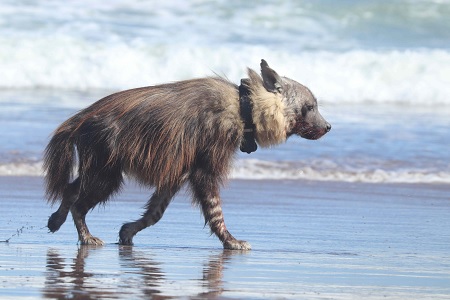
One of the near-threatened large carnivores found within Namdeb’s mining licence areas, as classified by the International Union for Conservation of Nature (IUCN), is the brown hyena.
The brown hyena is considered one of the rarest species of hyena which are only found in Namibia, Botswana, Zimbabwe, Mozambique, Eswatini, and South Africa.
The Namibian brown hyena is known for its extensive roaming patterns and adaptation to harsh environments.
This makes them a powerful predator in these relentless coastal and desert environments undoubtedly affecting the entire ecosystem, as they roam vast distances, survive on scarce and unpredictable food sources, and play a critical role as scavengers and ecosystem regulators.
By cleaning up carrion including marine-based food sources such as Cape fur seals, brown hyenas help prevent disease spread and maintain ecological balance across desert and coastal systems.
Understanding their movements, genetics, diet and behaviour is therefore fundamental not only to species protection, but to safeguarding the integrity of the broader ecosystem, and Namdeb is honoured to be able to contribute to efforts to protect the brown hyena.
Since 1997, Namdeb has supported the Brown Hyena Research Project (BHRP), in collaboration with the Ministry of Environment, Forestry and Tourism in Namibia to address conservation issues on brown hyenas and their main prey species, the Cape Fur Seal.
As part of due diligence, Namdeb continues to conduct specific research on roaming patterns, behavioral aspects of the Brown Hyena at Elizabeth Bay and Pocket Beaches to better understand the possible impacts mining can have on this species.
Since 2025, this work has expanded into Namdeb’s Southern Coastal Mine (SCM) and Karingarab, with objectives that include understanding population dynamics, movement and roaming patterns, genetic diversity, and dietary requirements, partnering with BHRP and the University of Namibia (UNAM) to assist with a study designs.
By acquiring not yet known information which has been made possible through the company’s contribution and truly understanding the role this species plays in the harsh, yet beautiful ecosystem of the Namibian desert, we can shape the approaches to the areas that they occupy.
Through gaining more insight into this species it has shown the world how unique the Namibian biodiversity is. One of the key lessons emerging from brown hyena research is that conservation should not be viewed as a restriction, but as a form of responsible management.
Understanding how a rare carnivore uses the landscape allows for better-informed decisions, from where infrastructure is placed, to how rehabilitation is approached, and how long-term land use is planned.
Finally, biodiversity projects are not easy but they must be weaved into a company’s strategy.
Historically, legal compliance has driven biodiversity action, but today, companies increasingly recognise the intrinsic and strategic value of protecting ecosystems for long-term business resilience.
Of course, biodiversity conservation should not have impact on a company’s economic goals, but the two should complement each other.
Creating management plans that speak to biodiversity conservation within the company, and its operating environment makes biodiversity conservation part of the operational strategies rather than an add on.
I refer to the mitigation hierarchy, a framework to manage risks to biodiversity and the environment (avoid, minimise, rehabilitate/restore, and offsets), companies can manage its potential impact on the environment without risking any economic implications.
Equally important is the sharing of research findings through national platforms with key institutions, ensuring that knowledge contributes to policy, public awareness and long-term conservation outcomes.
Information sharing at ground level is just as important as working with key institutions.
At Namdeb, it is more than just monetary contribution towards biodiversity, but we engage with local schools and our community to ensure everyone understands the vital role of the brown hyena and the importance of the research we do and support.
The conservation of the brown hyena illustrates how responsible mining today can contribute to a better tomorrow, actively ensuring biodiversity protection while supporting economic development.
These efforts show that Namibia offers the world more than natural diamonds, it offers proof that with commitment, collaboration and knowledge, development can leave ecosystems much stronger, a legacy worthy of both the land and the gems it yields.

– Dene Namukomba is the Environmental Officer at Namdeb.