
Allium cepa, commonly known as onion, is a controlled crop conventionally produced during the cooler months of the year in Namibia.
At present, onions are produced across all seven (7) production zones of Namibia at varying scales, with some farmers producing at small-scale for their own consumption and others producing at commercial scale for markets.
Onions are a common ingredient in many household dishes; therefore, growing them ensures a market for the producer.
Mr Hanks Saisai, the technical advisor on crops and poultry at the Agricultural Bank of Namibia (Agribank) said that it is necessary for farmers to have a basic understanding of how to cultivate this crop for optimal results.
“The first and most important factor in onion production is the soil in which onions are grown,” said Saisai.
“Onions can be produced in a variety of soils, but loamy soils typically yield the best results. The ideal soil for onion cultivation should have the following properties: the soil should be well-drained, well-aerated, and have a pH range of 5.5 to 6.5. Additionally, temperature plays a crucial role; the ideal temperature range for onion production is 18 – 22 oC.”
A critical factor that many farmers overlook is the ideal sowing time for onion seeds, as well as the methods used for sowing.
“The most common periods for sowing onion seeds are towards the end of March or early April. When it comes to seed sowing methods, onions can be sown directly into the production seed beds or in seedling trays for later transplantation into production seed beds.
“It should be noted that onion seeds are relatively small in size; therefore, the recommended sowing depth is 1 – 2 cm in both seedling trays and seed beds.”
Furthermore, Saisai stated, onions should be grown according to spacing recommendations.
“The spacing between rows should be at least 15 cm, whilst the spacing within rows should be at least 7 cm. It is worth noting that these specifications can vary depending on the variety of onions one intends to plant.
“In addition, the growing period can be between 90 and 200 days, depending on the variety. Varieties such as Texas Grano onion typically have a maturity period of 90 to 110 days from transplanting, though some sources cite 115–240 days depending on the region and whether they are grown from seeds or sets.
“During the soil preparation stage, farmers should apply manure and incorporate it into the soil. To this end, it is vital for farmers to test their soil to determine the available nutrient reserves. Based on soil analysis results, a fertilization program can be developed and followed throughout the growing season.
“For example, NPK (2:3:2 or 2:3:4) is widely used in many onion production operations over the growing period. Another vital aspect to consider when growing onions is the water requirements of the crop during the growing period.”
Saisai pointed out that on average, onions require between 400 and 600 mm of water over the entire growing period.
“Therefore, the irrigation system a farmer uses should be able to supply 400 – 600 mm of moisture to each onion plant over its growing period.
“Lastly, when growing onions, it is important to consider the potential yield. In Namibia, the average yield for a 1 Ha operation typically ranges from 30 to 40 tons (30,000 to 40,000 kg), provided that spacing recommendations, irrigation practices, fertilizer application, and sowing depth are followed correctly.”
Saisai said that in well-managed operations farmers can achieve yields of about 60 tons (60,000 kg) per hectare, making onion production a worthwhile venture.
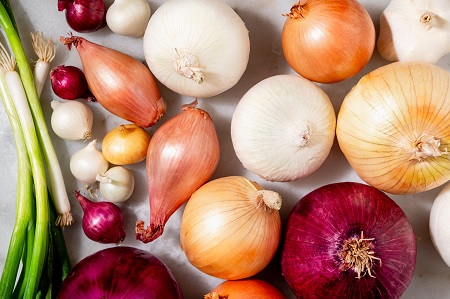
In the photo: There are many different types of onions.